
[et_pb_section admin_label=”section”][et_pb_row admin_label=”row”][et_pb_column type=”4_4″][et_pb_text admin_label=”Text” background_layout=”light” text_orientation=”justified” text_font_size=”14″ use_border_color=”off” border_color=”#ffffff” border_style=”solid”]
When one of South River Asset Management’S investment team caught up earlier this year with Australian lithium concentrate supplier, spodumene producer PILBARA MINERALS, it was clear to her and to the team that something pretty fundamental was going on.
Following a detailed analysis of industry dynamics we invested for clients where suitable and they have seen a 75% return as the lithium price has risen from $8,000 a tonne to $15,000 a tonne.
In fact, so spectacular has been the rise in demand for lithium that since end of 2015 the price of lithium carbonate has staggeringly tripled to $15,000 a ton, leading the Economist to describe it as the new “precious metal”.
While this may be a stretch ($15,000 a tonne equates to $1 an ounce versus next best precious of silver of $17 an ounce) nevertheless it’s impressive for a metal that after all is not exactly rare. Lithium is the third element in the periodic table.
Lithium price in US$ 2016…

Source: Citigroup
However its crucial property is its light weight and how much power it can pack into a very small space. It offers decent charge times and herein lies the secret as to why lithium-ion batteries are becoming so popular.
So what’s behind the excitement?
In this week’s South River Asset Management blog we explore the way the ev market is disrupting conventional applications but has the potential too to disrupt considerably further the whole supply chain from battery makers like SAFT at the smaller end (company is the supplier of choice to the LOCKHEED F-35 programme) and GS YUASA, Japanese supplier of the lithium-ion battery to the Boeing Dreamliner, to the very larger end NGK with its vast NAS battery able to power refineries and solar farms.
To the bulls these developments are nothing less than a technological revolution so profound that we may even be seeing the replacement of the internal combustion engine itself, with the onset of the electric vehicle (EV) market having the potential to disrupt transport in the same way the internet disrupted retailing and wider distribution channels in the last ten years.
And it’s not just motor transport.
The evangelists would have you believe that power storage and the ability to harness vast quantities of power in relatively transportable blocks will revolutionise industries from the electricity grid to chemicals to space and air travel. Japanese technology giant NGK’S vast NAS battery is now providing stand-alone power to solar farms and refineries, while GS YUASA’s lithium ion powers the Boeing 757 Dreamliner.
And the news flow has turned from a stream into a torrent as the major players position themselves to benefit from these newly emerging technologies:
- US car company TESLA announced it had received a staggering 350,000 orders for its new family “3” electric vehicle and was upping production capacity to 500,000.
- Chinese President Xi Jinping called for 5m ev’s in China by 2020.
- French oil company TOTAL announced it was buying SAFT, the world’s oldest battery maker, for $ 1.2bn and a 36% premium to the market price on the Paris stock exchange.
- ALBERMARLE the world’s largest lithium manufacturer following its takeover of rival ROCKWOOD last year announced better than expected Q1 results.
- TIANQI LITHIUM, China’s leading lithium company, bought TALISON LITHIUM, via a joint venture with ROCKWOOD, Australian owner of western Australia’s “Greenbushes Lithium,” the world’s largest known reserves of spodumene minerals, for an ev of $950m.
These five major developments show how fast moving this market is as investors assess uneasily just how powerful this boom is likely to become.
Karl Benz may be turning in his grave…
The internal combustion engine may even be faced with extinction as advances in battery technology threatens its very existence. Up until now the ev market has been a niche market inhabited by larger players like GM Nissan and Toyota who have been developing primarily hybrids like the Volt the Leaf and the Prius but Musk’s new hatchback is likely to change everything. (see below).
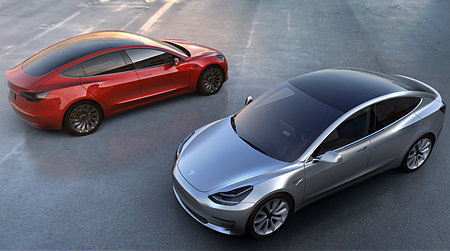
Out of 90m cars sold annually today 1.5m are ev’s. It is estimated by the UK’s SMMT that this figure will rise to 1m+ by 2020 and perhaps 5m by 2025. Keep in mind the average ev battery is 20 kg. Lithium supply demand today is roughly in balance at 36,000 tons per annum but demand moves ahead of supply this year as battery demand (33% of global lithium demand) accelerates sharply with the key ev demand increasing at between 15% and 20% per annum.
Global lithium supply
The global market for lithium is dominated by three producers. One is Chilean SQM which is now owned by the Chinese Citic Corp and the other two are ALBERMARLE/ROCKWOOD and FMC both large US quoted chemical companies. In Australia via spodumene the key “Greenbushes” plant in western Australia produces 40% of the world’s spodumene but will be joined by PILBARA in 2017.
And the losers…these may well be diesel engine makers that use platinum (40% of global platinum demand is made up by catalytic converters). Although perhaps coincidental (though conspiracy theorists would demur) VW and the other great European internal combustion engine makers are being heavily criticised and fined for emitting higher than permitted pollutants.
[/et_pb_text][/et_pb_column][/et_pb_row][/et_pb_section]