
[et_pb_section admin_label=”section”][et_pb_row admin_label=”row”][et_pb_column type=”4_4″][et_pb_text admin_label=”Text” background_layout=”light” text_orientation=”left” text_font_size=”14″ use_border_color=”off” border_color=”#ffffff” border_style=”solid”]
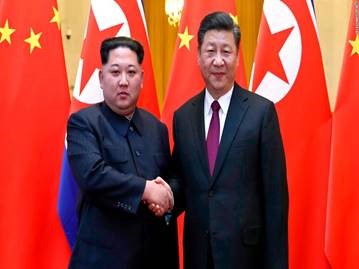
As world headlines laud the massive step towards peace by the two guys who became instant bookies’ favourites to receive the Nobel peace prize next year, the media has forgotten the person who actually orchestrated this deal at a meeting a few months ago in Beijing.

The agreement in fact ultimately benefits China first and foremost. China’s second stage economic growth policy is heavily based on the One Belt One Road trading block, and to execute this grand plan they will look to project power over the Asian seas and trade routes. For the last ten years, China has been flexing its muscles in the South and East China seas as well as the Indian Ocean. Subs pop up constantly throughout those seas and prompted the Malabar 2017 exercises in which India, Japan and the US took part demonstrating the latest anti-submarine technology. Also, it is the case that by re-establishing control over Taiwan, is important to Xi Jinping’s personal legacy and status among the Chinese population who view the island as a renegade province. If Xi Jinping can pull off this national re-unification by liberating Taiwan, then he has something of great value to record in Chinese history books.
The democratic island of Taiwan (officially the Republic of China) is separated from mainland China (the People’s Republic) by a thin stretch of water and has been self-governed since a bloody civil war ended in 1949. The constant American sea patrols and political support are the main impediments to re-unification and a thorn in his side. The essence of the recent agreement includes Korean denuclearising under a formal weapons inspections programme, US troop withdrawal from South Korea and the likely reduction of trade sanctions against North Korea. The significant reduction in the circa 30,000 troops in South Korea ultimately benefits China though not so much North Korea. The naval exercises and war games might annoy North Korea, but nobody truly believes after over 50 years they are going to invade the South. They are not there to support South Korea against North Korea, despite that being the headline reason since the 1953 armistice was signed, but rather as a bulwark and part of a US forward base in Asia, which along with Guam and Okinawa has allowed the US with its formidable navy to police the South China Sea, and to defend the entire Asian peninsula against Chinese hegemony. In January, Trump issued a challenge to Xi Jinping via tweet, if you want to control Asia then step up and deal with rocket boy. And they did, Chinese style. It’s not surprising defence stocks have taken a hit these last few days and market heavyweights LOCKHEED and RAYTHEON have underperformed the S&P by circa 10% since the announcement on 9 March of the White House’s intention to organise a summit between the two leaders. Peace doesn’t need an army.
‘I explained to the President of China that a trade deal with the U.S. will be far better for them if they solve the North Korean problem!’ Trump tweeted in April 2017. There is sure to be a side deal as well, US rhetoric against China lately has been significantly lowered while that against old allies in Canada and Europe conversely ratcheted up at last week’s G7 summit. Assume a trade deal too with China that significantly reduces US China trade imbalances as the other part of this deal to come out shortly. Trump is a businessman, he sees where the money is, it’s in Asia, and he’s pivoting away from a creaking EU with its protectionist trade policies, increasingly socialist economic policies and questionable moral superiority, and towards Asia, where growth is actually coming from, where he can do a deal and where both American and Chinese interests can be best served. Donald’s Trump’s negotiating style – hit as hard as you can and then compromise – has worked well in dealing with Kim, at least judging by the apparent outcome of last week’s Singapore summit. It has also worked well throughout Trump’s career as a real estate developer.…the art of the deal is alive and well and it’s between America and China and America, North Korea was just the warm up.
[/et_pb_text][/et_pb_column][/et_pb_row][/et_pb_section]